

Stainless steel gratings
and lattice saddles
for food processing
Corrugated grating, pressed grating, welded grating, or bar grating—custom-designed to suit the product, process, and load.
Compare Types of GridsCustom Design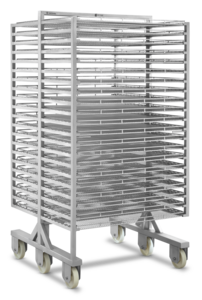
MOHN Stainless Steel Grating
Which type of mesh gratings is right for your process?
Not every product support structure fulfils the same function. The design influences product support, air circulation, potential grid imprints and – depending on the design – also cost-effectiveness for larger production runs.
That is why the four designs are compared directly with one another.
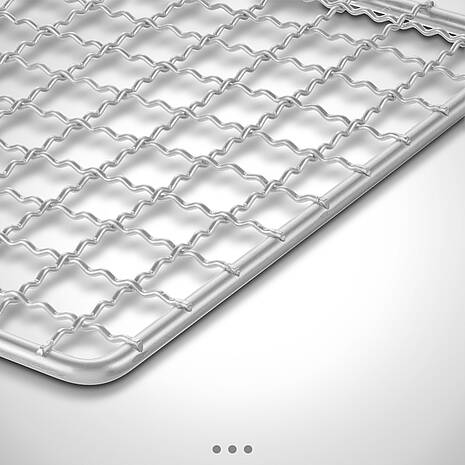
Grating / Grid with corrugated mesh
Distinctive contact geometry. Depending on the product and process, a visible wavy pattern may result.
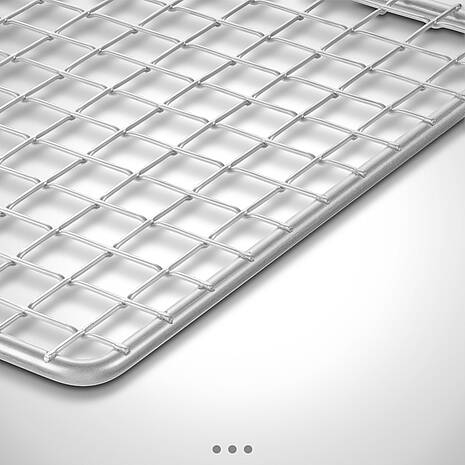
Grating/ Pressed-wire mesh grids
Of the three wire mesh options, this one offers the best conditions for minimizing the product's footprint.
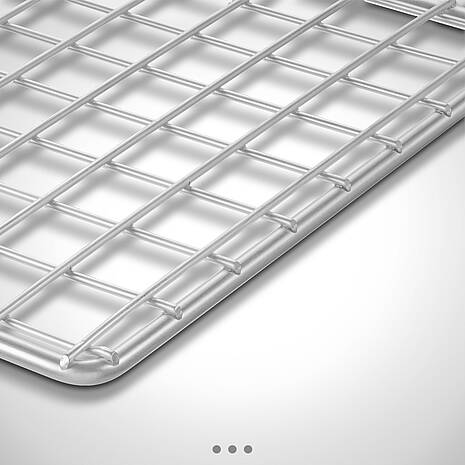
Grating/ Welded mesh-grids
Robot-manufactured lattice structure. Economically viable for runs of 50 or more identical pieces, since setup costs are spread across the production run.
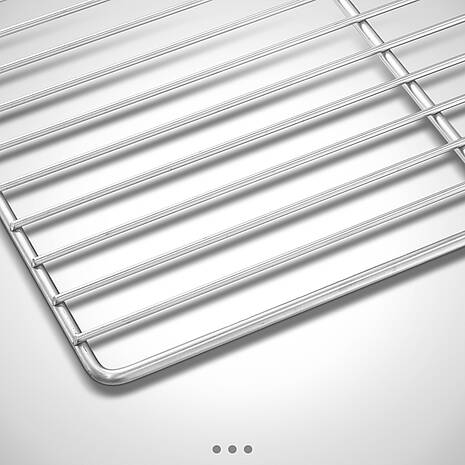
Grating / Grid with web bars
Large open cross-sections for air, smoke, and heat; very little material is located directly beneath the product.
Corrugated grating, pressed grating, welded grating or bar grating?
Direct comparisonThe key differences at a glance.
| Feature | Corrugated mesh | Pressed mesh | Welded mesh | Web grating |
|---|---|---|---|---|
| Support | corrugated | largely straight | straight-line wire mesh | open bar/web support " |
| Product imprint | clearly possible | particularly low | straight-line pattern possible | depends on product/web spacing |
| Free cross-section | good | good | good | particularly good |
| Main advantage | characteristic support | minimal imprint | suitability for mass production | product flow |
| Customisation | yes | yes | yes | yes |
| Load | individual | individual | individual | individual |
What effect does rust have on the product’s surface?
Product imprintProduct properties, weight, temperature, process duration and support geometry all play a part in determining the extent to which a rust structure can be transferred to the product.
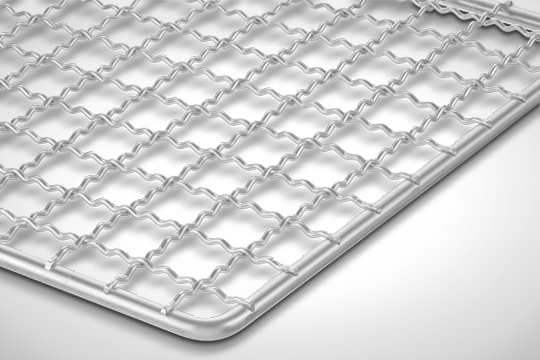
WAVE GRID – textured product surface
Waves in the wires create a characteristic contact pattern. Depending on the product’s weight, composition and the duration of the process, this pattern may be visibly transferred to the product’s surface.
Advantages / Selection criteria
- Customisable grate dimensions
- Mesh sizes tailored to the application
- Wire thickness and support struts according to load
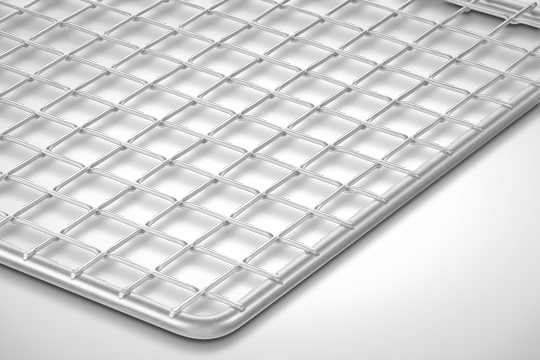
PRESSED MESH – when the product’s surface finish matters
The largely flat contact surface on the product side minimises a pronounced grid pattern. This makes the embossed grid particularly suitable when the final appearance of the product is of great importance.
Advantages / Selection criteria
- Least visible imprint of all wire mesh variants
- largely flat contact surface
- For visually sensitive products
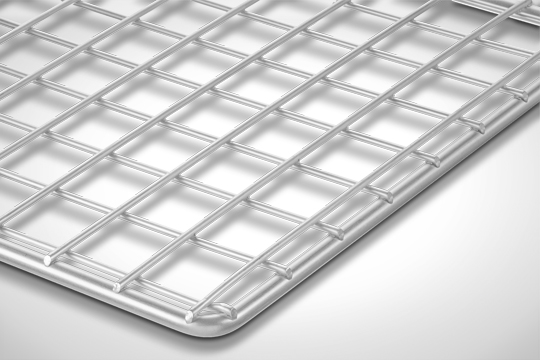
WELDED MESH – Cost-effective mass production
In the case of welded mesh, wires arranged in straight lines are welded together using robotic technology. From around 50 identical mesh panels onwards, this production method becomes particularly cost-effective, as the necessary set-up times are spread across a larger batch.
Advantages / Decision-making criteria
- Robotic production
- Economically viable from around 50 identical units
- Reproducible series production
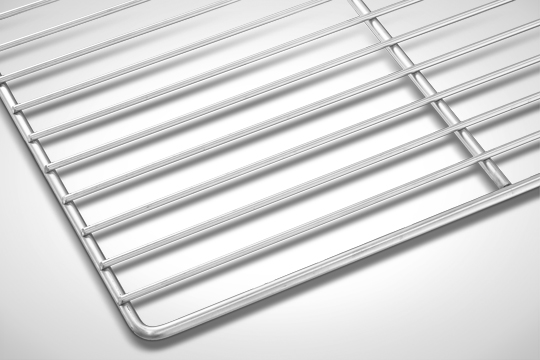
WEB BARS – open design for process air
The support structure consists of stainless steel web bars or struts arranged in parallel. Large open spaces remain between the support elements to allow for the passage of air, smoke or heat.
Advantages / Selection criteria
- large clear cross-sections
- Reduced contact area with the product
- also ideal for maturing processes
Web bar grid as a maturing rack for cheese
In the case of cheese products, product support and air circulation must be coordinated. The spacing and stability of the support can be adapted to the size, weight and firmness of the cheese in question. In this way, product support, air circulation and mechanical stability can be coordinated through the design.
Single, double or railing frames
Frame designsThe frame design is selected to suit the load, handling and product security requirements.
Single frame
Compact basic modelPerimeter framing of the lattice truss; support struts as required to ensure the necessary load-bearing capacity.
Double frame
For higher loads
Additional structural strength for heavy loads or correspondingly large or heavy products.
Balustrade frame
Edge protection & product protectionA raised edge to protect the edges and – depending on the product – provide additional lateral support to prevent slipping or falling.
Handle options
Depending on the application, the mesh trays can be supplied without a handle, with a straight handle or with a 60° angled handle. The choice depends on loading, unloading, the feeding concept and ergonomic handling.
Dimensions, mesh size and load capacity depending on the application
Customised design| Basic dimensions | Width x depth x height to suit existing plant, trolleys and process systems. |
|---|---|
| Mesh sizes | Commonly 25 x 25, 30 x 30 and 40 x 40 mm; other designs available on a bespoke basis. |
| Wire thickness | No typical standard wire thickness. Design is deliberately based on the actual load. |
| Support struts | Number and arrangement depending on grating size, product weight and total load. |
| Load-bearing capacity | Each version is individually engineered – there is no standard load capacity. |
Stainless steel suited to the process, hygiene and product
Materials & SurfacesTried-and-tested stainless steel for a wide range of applications in the food industry.
Optional for particularly demanding operating conditions.
Optional, depending on process and customer requirements.
Removal of production-related tarnish and surface changes.
Electrolytically smoothed surface; easy to clean.
Can reduce product residue, make removal easier and aid cleaning.
Grating for various food processing operations
ProcessesProducts and Sectors
|
|
|
|
|
|
|
|
Which version suits which priority?
Decision matrixPressed mesh
Corrugated mesh
Welded mesh
Grating
Grating
Double frame
Balustrade frame
all versions
To ensure your enquiry is as specific as possible, please provide the following details: product, product weight, grate dimensions, required quantity, process and existing plant.
Frequently asked questions about stainless steel grating
FAQCorrugated mesh has a corrugated structure, pressed mesh has a largely straight surface, and welded mesh has a straight, robot-weldable mesh structure.
Of the three types – corrugated mesh, pressed mesh and welded mesh – expanded metal offers the best conditions for minimising the visible imprint as much as possible.
Large clear cross-sections facilitate the flow of air, smoke or heat around the product and reduce the contact area with the product.
The spacing and stability of the support can be adjusted to suit the size, weight and firmness of the cheese; the open design promotes air circulation.
From around 50 identical lattice saddles onwards, robot-assisted production can make economic sense, as the necessary set-up times are spread across the production run.
Sizes of 25 x 25, 30 x 30 and 40 x 40 mm are commonly used. Other mesh sizes are available depending on the product and process.
There is no standard wire thickness that applies across the board. The dimensions are determined according to the size of the grate, the weight of the product and the total load.
Where the product’s weight, dimensions or the manufacturing process require greater mechanical stability or a higher load-bearing capacity.
If edge protection or additional lateral product support is required, for example for meat or sausage products.
1.4301 as standard; depending on the process and requirements, 1.4401 or 1.4571 may also be used.
Yes. A suitable PTFE-based non-stick coating can reduce product adhesion and make cleaning and product removal easier.