

Reference project Schnabels
Industrial washing system for cleaning and drying Euro-standard containers
Josef Schnabels GmbH & Co. KG, based in Georgsmarienhütte, Germany is a family-run business in the meat industry. Since 1963, the company has specialised in the cutting and custom processing of pork, beef and poultry.
A high-performance continuous-flow washing system has been integrated into the existing in-house container logistics system to clean the Euronorm containers used in the production process. The system is designed for E1, E2 and E3 containers and combines automatic feeding, cleaning, rinsing, air-drying and onward conveyance to the crate store into a continuous process.
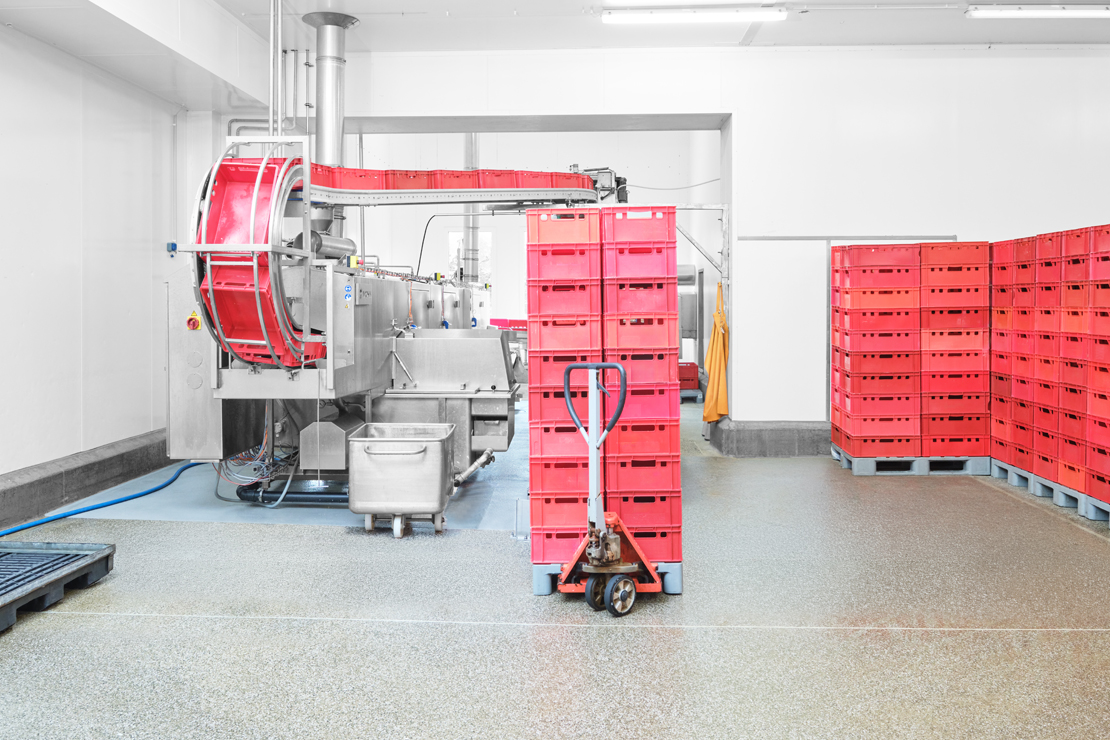
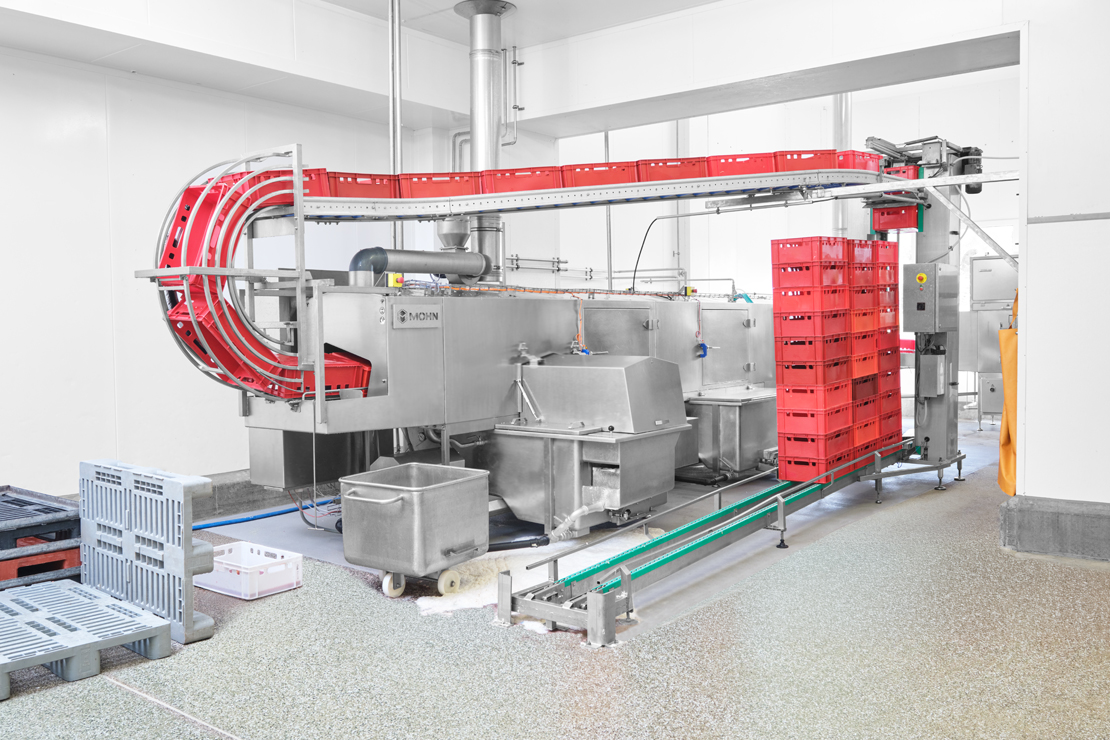
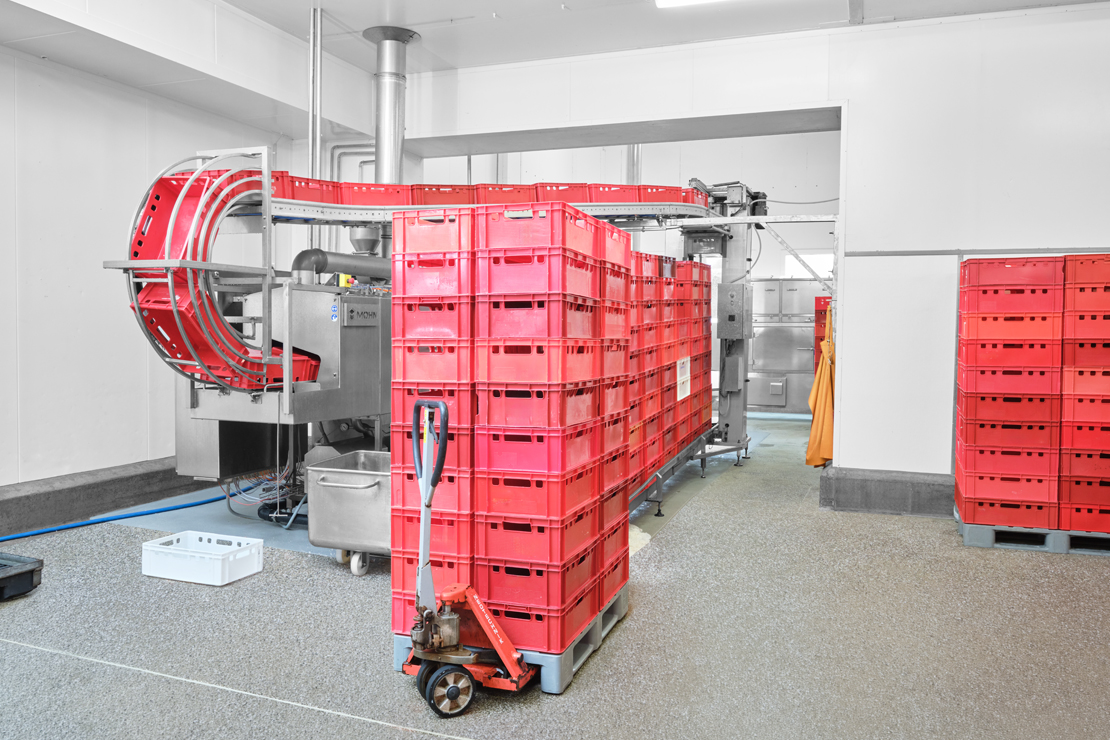
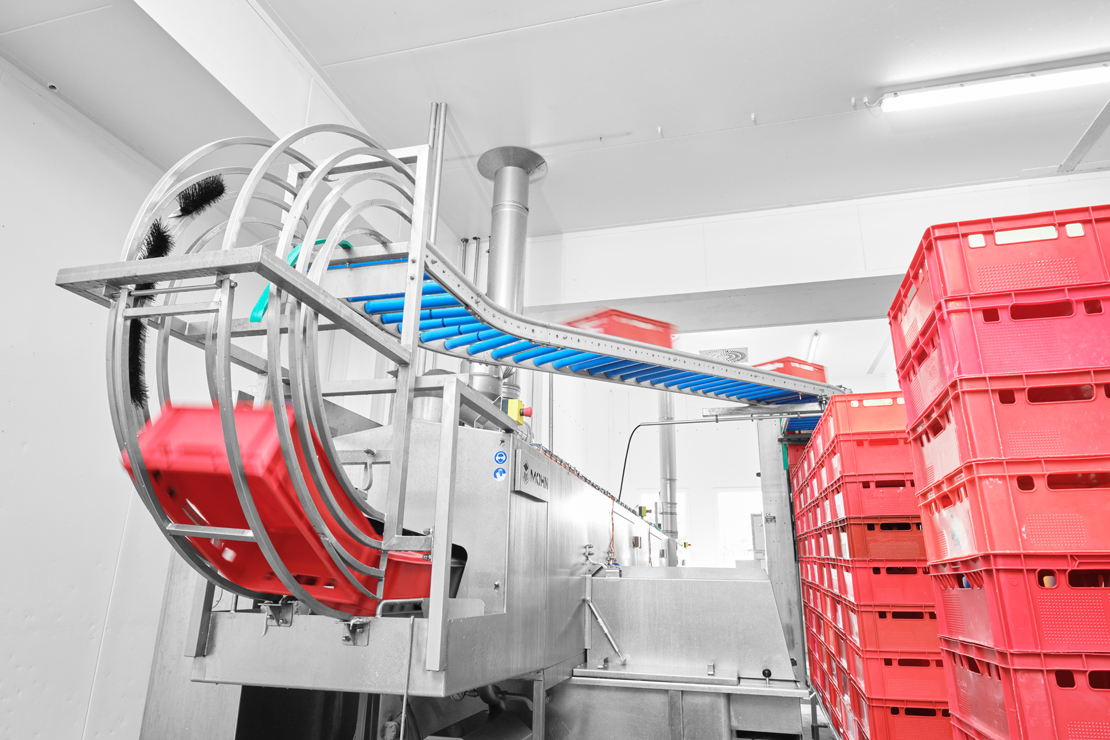
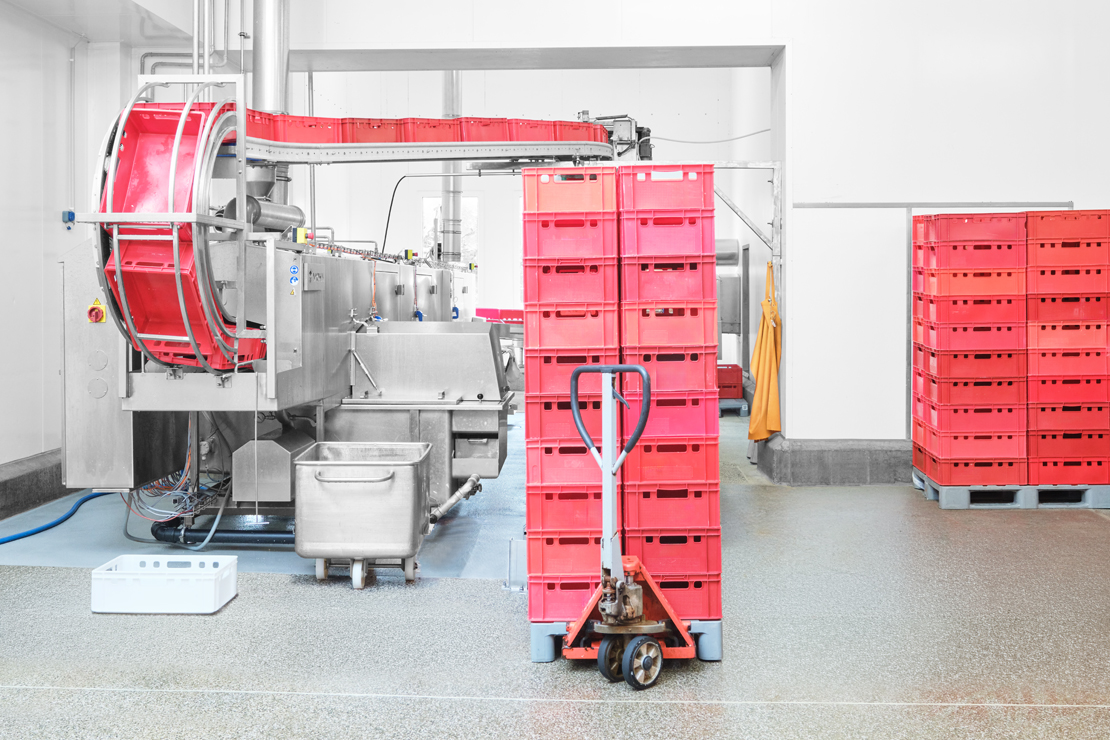
In-line automated cleaning and blow-drying of E1, E2, and E3 Euro-standard containers – click on the images to enlarge. | Mohn GmbH
Customer requirements and tasks
The aim of the project was to develop a high-performance cleaning solution for Euronorm containers that integrates seamlessly into existing operational processes. The focus was on a continuous flow of materials: from the automated feeding of soiled crates, through the washing and rinsing process, to the transfer of the almost dry containers to the existing crate store.
- Cleaning of Euronorm containers of types E1, E2 and E3
- Continuous cleaning in the longitudinal direction of the containers
- Designed for 800 to 1,000 containers per hour
- On-site connection to an existing destacking system
- Automatic feeding of soiled containers from above into the inlet area
- Designed as a washing module with a separate blow-off module downstream
- Connection of the two modules via a driven 90° curve with a roller conveyor
- Uniform timing of the crates prior to blow-drying
- Onward transport of the cleaned and almost dry containers via an outlet roller conveyor into the crate store
- Heating primarily via existing hot water from the combined heat and power plant
- Customised control system designed as a relay-based control system
Project description and key features
A DLWA-1000-3T Highline BS-3 continuous-flow washing system, made from 1.4301 stainless steel, is used for the automated cleaning of E1, E2 and E3 Euro-standard containers. The containers pass through the system continuously in a longitudinal direction, where they are cleaned, rinsed and then blown dry.
The total washing time is – depending on the set throughput – around 45 seconds for 1,000 containers per hour or approximately 55 seconds for 800 containers per hour. The system design comprises two functionally coordinated main modules: the washing module, which includes pre-washing, main washing and rinsing, and the separate blow-off module for the targeted reduction of residual moisture.
Automatic feeding via the existing destacking system
The soiled Euronorm containers, which are supplied on Euro plastic pallets, are transported by an employee using a forklift truck to the powered roller conveyor, where they are pushed onto the conveyor line. From this point onwards, the on-site destacking device takes over the rest of the process: it automatically separates the stacked crates and transfers them in a precise, synchronised manner from above to the inlet of the washing system.
In this way, manual work is limited to preparing the pallets and pushing the containers onto the receiving roller conveyor. The subsequent feed into the cleaning process is automated and ensures a consistent flow of material.
Washing module with pre-wash, main wash and rinse
Following automatic separation by the on-site destacking device, the Euro-standard containers are fed via a roller conveyor to the crate turner. This rotates the containers into the required cleaning position before they enter the washing module, so that the open top faces downwards during the washing and rinsing process.
This allows the wash and rinse water to drain freely without collecting inside the container. At the same time, the container turner ensures the orderly transfer of the containers to the driven inlet of the washing module and guarantees a smooth transition into the subsequent pre-wash and soaking zone.
Over a length of 3,600 mm, adhering dirt is loosened by an intensive spray of wash water and prepared for the subsequent main cleaning stage. The 4 kW pre-wash pump used for this purpose delivers a flow rate of up to 1,200 litres per minute at a working pressure of 1.5 bar. This ensures that the container surfaces are treated evenly before they enter the main wash.
In the subsequent main wash zone, which is 2,700 mm long, the Euronorm containers undergo intensive cleaning. A main wash pump with an output of 11 kW provides a flow rate of 1,000 litres per minute at 5 bar for this purpose. The wash tank is primarily heated using hot water from the combined heat and power (CHP) plant. The flow temperature is approximately 60 to 70 °C.
After the main wash, the Euronorm containers pass through the 2,700 mm long rinse zone. First, they are treated with recirculated rinse water, which is supplied by a 1.5 kW pump with a flow rate of 500 litres per minute at 1.5 bar. The rinse tank is primarily heated using the hot water available from the combined heat and power (CHP) plant; a 10 kW electric heating element assists with maintaining the temperature where necessary.
The cleaning process concludes with a fresh-water rinse. Softened water with a hardness of approximately 2 to 6 °dH is used for this purpose. A 10 kW rinse boiler heats the fresh water – with an inlet temperature of at least 50 °C – to between 75 and 85 °C. With a flow rate of around 300 to 400 litres per hour, residues from the previous wash and rinse cycles are reliably removed from the tank surfaces.
Filtration technology for high container volumes and high levels of contamination
To support the washing process, the system is equipped with a TRF-DLWA I-90° drum filter. The rotating drum separates dirt particles from the washing solution. An internal screw conveyor feeds the residues into an external collection tank, which can be easily removed for emptying.
In addition, two external filter tanks for primary washing and final rinsing are integrated. These aid in the removal of dirt, particularly when dealing with large tank volumes and heavy soiling. The filter tanks are made of 3 mm stainless steel and feature access holes, funnel overflows and rounded, neatly polished inner edges.
Separate blow-off module to reduce residual moisture
Due to the spatial constraints, the system was designed in an L-shape. After the washing module, a motorised 90° bend guides the cleaned Euro-standard containers into the separately located blow-off module. There, they first pass through a 1,000 mm-long neutral zone before entering the subsequent 2,700 mm-long blow-off section.
Three adjustable ELEKTROR high-pressure fans, each with a 4 kW motor, blow the water remaining on the container surfaces away in a targeted manner. LENZE inverters allow the fan output to be adjusted as required. This significantly reduces the residual moisture after rinsing, before the containers are conveyed via the outlet roller conveyor to the crate store.
For new E2 containers, a residual moisture content of approximately 6 to 8 grams per container was determined using the weighing method. The actual result may vary, depending on the container type, condition, geometry, degree of soiling and the respective environmental conditions.
Mist extraction and low-maintenance design
The moist air generated during the washing process is extracted via a vapour extraction system. In this system with blow-off, the extraction point is located within the neutral zone. The DN 250 stainless steel pipework directs the exhaust air to a stainless steel radial fan with a capacity of around 1,500 m³/h at 500 Pa.
For maintenance and servicing work, the interior of the machine can be accessed directly via an additional door at the rear. This allows necessary work to be carried out without having to access the unit via the operator side or adjacent conveyor systems. Integrated proximity switches monitor the door position and contribute to the safe operation of the system.
The double-door Rittal HD control cabinet is positioned directly next to the washing system. Its hygienic design, featuring stainless steel cable glands and an IP69 protection rating, is tailored to the cleaning conditions in the production environment. The control system thus remains directly accessible during the process whilst being protected against the moisture generated during cleaning.
Outlet roller conveyor and onward transport to the crate store
After being blown dry, the almost dry containers are transferred to a 3,000 mm long outfeed roller conveyor. A jam detector monitors the flow of crates. The cleaned Euro-standard containers are then conveyed directly to the existing crate store via the downstream conveyor system.
This creates a closed in-house process: soiled crates are automatically destacked, fed into the washing system, cleaned, rinsed, blown dry and then returned to the warehouse logistics system.
Video
and blow-down to the onward transport of Euronorm containers to the crate warehouse | Mohn GmbH
Summary
With the DLWA-1000-3T Highline BS-3 continuous washing system, Josef Schnabels GmbH & Co. KG has not only implemented a high-performance cleaning solution for E1, E2 and E3 Euro-standard containers, but has also made the entire container cycle more ergonomic and cost-effective.
A key advantage lies in the automated feeding of the soiled crates. The employee simply transports the containers – which are provided on Euro plastic pallets – to the intake roller conveyor using a pallet truck and pushes them onto the conveyor line. The downstream destacking device then automatically separates the containers and transfers them to the washing system at precise intervals. This significantly reduces the amount of manual labour and physical effort required, and eases the workload on staff, particularly when dealing with consistently high volumes of containers.
The coordinated conveyor system ensures that the crates are guided through the process – from destacking through cleaning and rinsing to air-drying and handover to the crate store – without any manual handling in between. This reduces unnecessary manual handling and internal transport routes, whilst ensuring the material flow remains consistent and well-organised.
The system is also optimised for energy efficiency in line with the existing infrastructure: the washing and rinsing zones are primarily heated using the hot water available from the combined heat and power plant. The supplementary electric heating is used specifically where it is required to maintain the temperature in the rinsing zone and for the final fresh-water rinse. In this way, the existing thermal energy is effectively integrated into the cleaning process.
Overall, the system solution combines high cleaning performance with container logistics that make work easier, more ergonomic loading and energy-efficient utilisation of the heat from the existing CHP plant.
If you have any questions about this project, we’d be happy to advise you by telephone on +49 (0) 2354 94 45-0,or you can use our contact form.
We’d also be happy to call you at a time that suits you. You choose the date and time. Simply use our call-back service for this.