

Reference project Küster
Industrial washing system for cleaning and drying metal sheets, baskets and baking tins
Bakery Kuester GmbH, based in Göttingen, Germany is a long-established artisan bakery founded in 1925. The company operates over 20 branches in and around Göttingen and employs over 200 staff, who use only the bakery’s own recipes without purchasing any frozen goods or industrial ready-made mixes.
In day-to-day operations, various trays, baking sheets, baskets, bread tins and transport containers are in circulation. The items to be washed differ not only in terms of their dimensions and design, but also in terms of the degree of soiling and the cleaning requirements.
A continuous-flow washing system had already been in use at the site since 2000. For many years, it formed a reliable part of the daily cleaning process and was particularly valued for its robust design. However, as the machine’s operating life increased, the cost of maintenance and repairs rose noticeably. At the same time, certain design features of this earlier generation of machinery no longer met today’s technical capabilities or the requirements for cost-effective system availability.
When the time came to replace the system, the decision was once again made in favour of a solution from Mohn. The decisive factors were the positive experience with the previous system, as well as the long-term guarantee of spare parts supply. Added to this were Mohn’s in-house service and maintenance team, as well as short response times should support be required during operation.
A DLWA-800 BACK-Highline BS3H basket and sheet metal washingsystem was installed for the cleaning and subsequent blow-dry of sheet metal, baskets, moulds, trays and other containers. From the inlet, through the main wash and rinse, to the blow-drying and handover at the outlet, the items to be washed undergo a continuous, coordinated cleaning process.
Customer requirements and tasks
The starting point for the project was the replacement of a continuous-flow washing system that had been in use since 2000. The new solution was intended to continue the tried-and-tested cleaning of the metal sheets, baskets, moulds and other equipment used in the plant, whilst at the same time meeting higher requirements in terms of cleaning performance, system availability and blow-dry efficiency.
Particular attention was paid to the cut-out sheets. These are fed through the system with their openings facing upwards. Due to their geometry, the cleaning nozzles must be able to reliably reach the internal surfaces and edges in particular. Compared with the previous design, the cleaning of these sheets was therefore to be significantly more thorough and uniform.
The items to be washed include, amongst others:
- 60/40 tinplate with four-sided flange, 600 × 400 × 25 mm
- Perforated and freezer trays
- Sheets measuring 590 × 390 × 50 mm and 770 × 570 × 50 mm
- Cut-out trays with a top opening, 580 × 400 × 50 mm
- Slotted sheets with top opening, 580 × 200 × 50 mm
- Roll tins, 640 × 420 × 150 mm
- Bread tins and small items in standard baskets
- Ringoplast and Euronorm baskets with standard dimensions of 600 × 400 mm up to a height of 320 mm
For trays and baskets with base dimensions of 600 × 400 mm, an hourly throughput of approximately 600 to 800 items was envisaged. The actual throughput achievable depends on the type and degree of soiling of the items being washed. In the case of more stubborn residues, the conveyor speed can be reduced so that the products remain in the individual treatment zones for longer. For example, the system can be operated at a rate of around 600 items per hour when dealing with heavily soiled baskets.
The adjustable conveyor speed allows the overall throughput to be flexibly adapted to different dimensions, geometries and cleaning requirements. Depending on the items being washed and the desired treatment duration, a throughput range of approximately 400 to 900 items per hour is possible.
A clearly structured, single-lane material flow was required for day-to-day operation. The various trays, baskets, moulds and equipment were to be guided safely through the system and made available at the outlet for manual removal. It also had to be possible to process taller baskets and containers up to a throughput height of 320 mm without additional handling or special manoeuvres.
Cleaning, rinse and air-blow drying should be coordinated in such a way that the cleaned items are available for the next stage of production with significantly reduced residual moisture. This facilitates rapid reuse in day-to-day operations, particularly for sheet metal, cut-to-size sheets and baskets.
Equally important was a maintenance-friendly design. Filters, nozzle arms and other components relevant to cleaning, inspection or servicing should be easily accessible so that routine maintenance can be carried out without extensive dismantling. The moist air generated during the washing process should also be vented specifically at the required points, without unnecessarily drawing heat away from the actual washing zones.
An ergonomic transfer height of around +1,000 mm was specified at the outlet. At the same time, the system was to be designed in such a way that, should operational procedures change in the future, the material flow could be integrated into downstream conveyor systems.
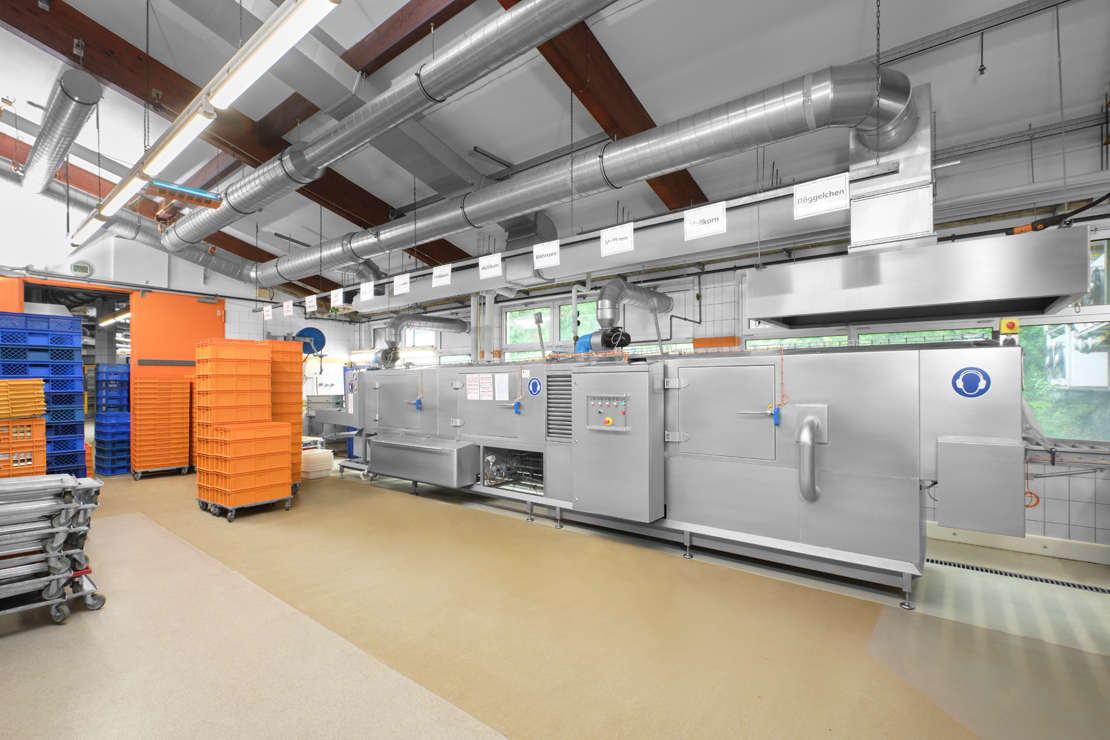
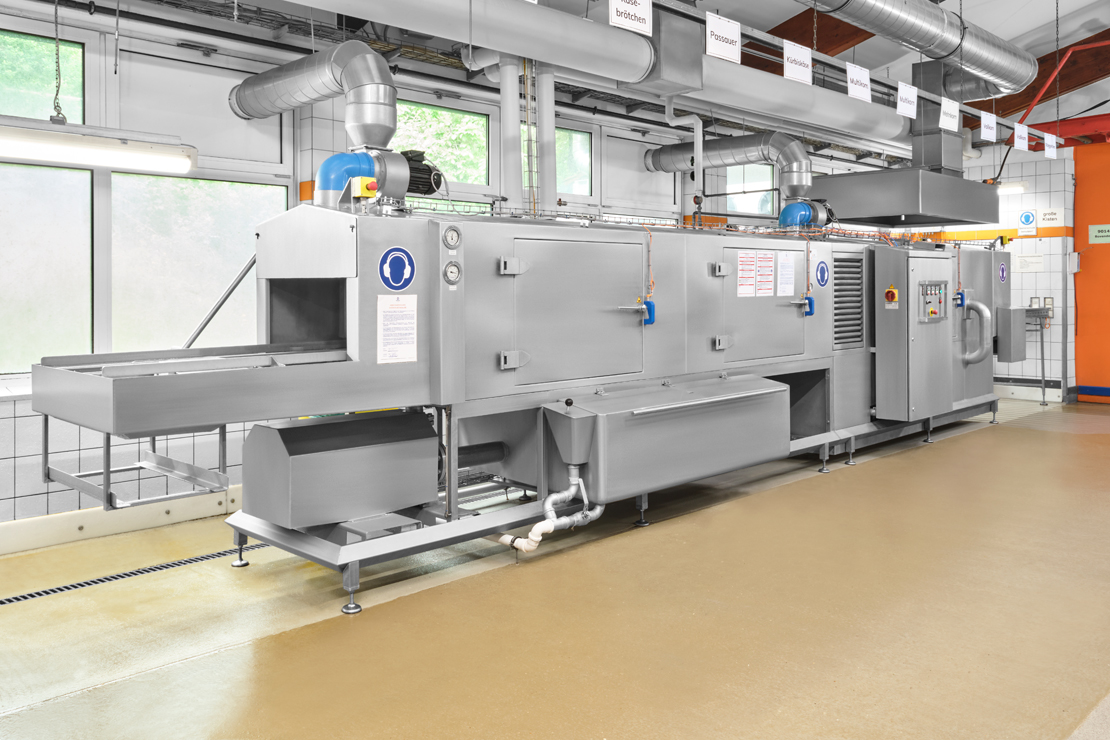
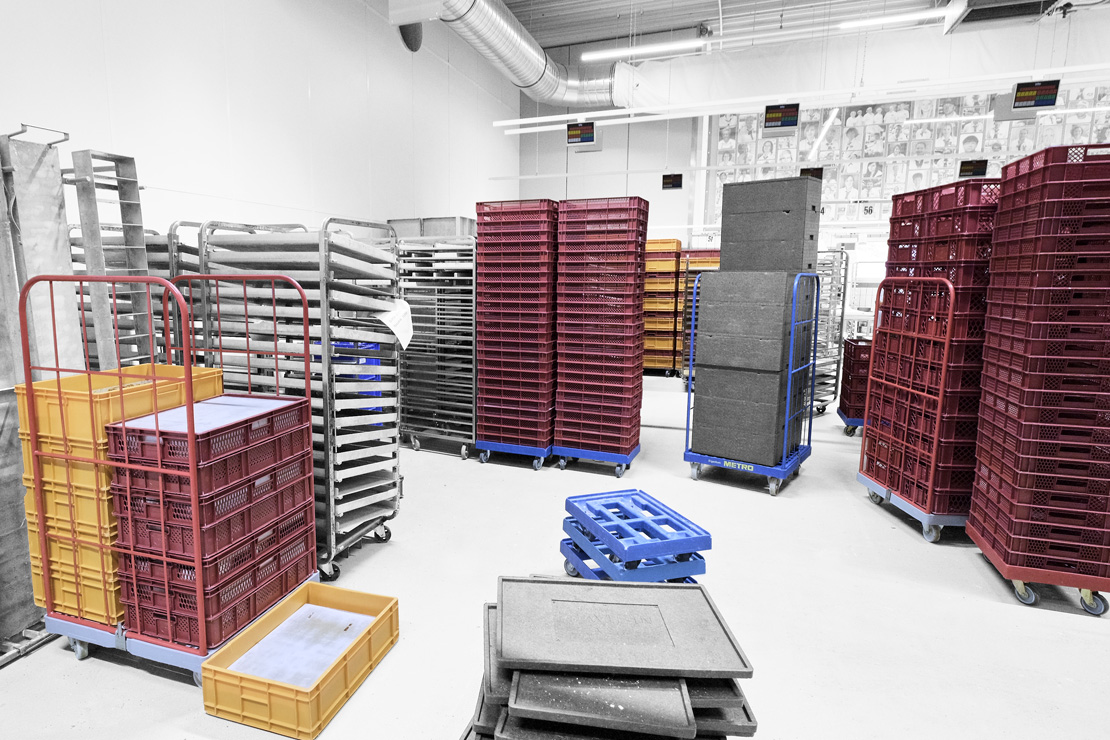
Industrial washing system for cleaning and drying sheet metal, baskets, and baking pans – click on the images to enlarge them.
Project description and key features
Single-lane feed with pre-installed conveyor system connection
The various metal sheets, baskets, moulds and other equipment are fed into the system in a single-lane configuration at an ergonomic transfer height of approximately +1,000 mm. The feed module, approximately 1,500 mm long, ensures clear and controlled material handling right through to the subsequent cleaning zones.
The design also allows for potential future developments in the material flow: a connection to existing or future conveying systems can be implemented as required. This ensures that the system can be flexibly integrated even if internal operational processes change.
Beneath the inlet is an openly accessible area containing a dirt collection bin. Coarser residues that enter the system with the items being washed can be collected there and removed as required without the need for complex intervention.
An extraction point is already integrated into this area. A stainless-steel radial fan specifically extracts the moist air escaping during feeding, thereby reducing the load on the feeding area. Extraction is deliberately carried out at the inlet so that heat is not unnecessarily drawn away from the actual main cleaning zone.
Main cleaning zone with strategically positioned cleaning nozzles
The 3,600 mm long main cleaning zone handles the central cleaning stage. Its wash tank holds around 800 litres of cleaning medium, which is continuously recirculated via a stainless steel centrifugal pump. With a motor power of 11 kW, the pump achieves a flow rate of approximately 2,000 litres per minute at 2.5 bar, thereby providing the necessary capacity for intensive treatment of items with varying geometries.
For this reason, the main washing zone was specifically tailored to the items being washed: Numbered nozzle tubes with integrated flat-jet nozzles spray the trays, baskets, planks, and molds with high pressure, ensuring intensive mechanical cleaning; the nozzle arrangement was designed so that the cleaning effect is not limited to exposed surfaces alone. The nozzle tubes can be removed without tools for cleaning and maintenance. Their numbering prevents mix-ups when reinserting them and helps ensure that the defined nozzle arrangement is maintained—an important prerequisite for consistent cleaning quality in daily operation.
This was particularly relevant for the cut-to-size sheets, which are fed through the system with their openings facing upwards. It is precisely the deeper internal areas and edges that place greater demands on the nozzle arrangement. Compared with the previous machine, the new design enables these areas to be incorporated into the cleaning process in a more targeted and uniform manner.
Practicality for everyday use was also a key focus in the design for cleaning and maintenance. The nozzle tubes can be removed without tools, making them quickly accessible for inspection or cleaning. The external filter tank is also easily accessible and helps to separate dirt particles from the cleaning medium. This means that necessary cleaning and servicing work can be carried out without extensive dismantling.
Hot-water heating and thermally insulated tunnel construction
The required temperature in the main cleaning zone is generated by a heat exchanger located in the wash tank, which is supplied with hot water. This type of heating specifically utilises the available heat in the cleaning process.
The fully welded machine housing is double-walled and designed to be thermally and acoustically insulated. This helps maintain a more consistent temperature within the tunnel, whilst limiting heat loss via the machine’s surfaces. At the same time, the design helps to reduce noise emissions in the production environment.
Compared with the previous system from the year 2000, the new solution is not solely focused on achieving a higher hourly throughput. The existing system already achieved a comparable capacity.
The progress lies rather in the further-developed design, the more efficient use of the energy employed, and the improved cleaning and blow-off performance.
Rinse cycle with fresh water used as required
After the main wash cycle, the items being washed first pass through a drip zone and then through the rinse cycle. In this final wet section, residues of the cleaning agent used previously are removed from the surfaces. At the same time, the fresh water supplied compensates for the evaporation and carry-over losses incurred during the process.
The system is designed to require approximately 400 to 500 litres of fresh water per hour for operation. Actual consumption depends on the degree of soiling, the selected flow rate, the detergent concentration and the type of items being washed. This allows the fresh water consumption to be adapted to practical requirements during operation.
Blow-dry with heated process air
Following the main cleaning and rinse cycles, sheet metal, baskets, planks and moulds first pass through a 500 mm long neutral zone. They then enter the 2,700 mm long BS3H blow-off module, where residual water is specifically removed from the surfaces.
Three blow-off units, each with a power output of 5 kW, work in conjunction with the stainless steel air blades to generate a concentrated air stream. This stream sweeps over the cleaned parts along the conveyor line and reduces the moisture remaining after the rinsing process before the items reach the outlet.
The residual water produced during the blow-off process is not discharged unused, but is recirculated back into the main cleaning system. At the same time, the process air used is heated via a hot-water heat exchanger. This is integrated into the return pipe of the heating water supply and utilises the available thermal energy for the blow-off process.
This represents a significant improvement on the previous system. The previous machine merely featured a simple blow-off system without additional heating of the process air. Consequently, its effectiveness was limited when processing sheet metal, cut-to-size sheets and baskets. Adjusting the upper blow-off to different heights also required considerably more effort.
The extended tunnel design, the targeted airflow and the heated process air all work together here. As a result, the cleaned parts leave the system with significantly reduced residual moisture and can be reused more quickly in the subsequent production process.
Mist extraction with reduced heat loss
The cleaning process generates moist, warm air which must be extracted from the system in a controlled manner. Two extraction points are provided for this purpose: one in the inlet area and another at the start of the blow-off drying stage.
The extraction system is deliberately designed not to operate directly within the active main cleaning zone. If the air were extracted directly from this area, heat – which is required to maintain the temperature during the cleaning process – would be lost along with the vapour.
Instead, the design utilises the slight overpressure inside the machine. The vapour escaping at the designated points is specifically captured and extracted via the extraction system. The moist air is thus collected where it would escape from the tunnel anyway, without unnecessarily drawing off the warm process atmosphere in the main cleaning section.
This design helps to reduce energy consumption. The project documentation cites a potential saving of around 30 kW compared with systems featuring direct extraction from the washing area. The actual effect depends, amongst other things, on the operating mode, temperature control and the system’s utilisation rate.
Outlet with lift-up roller conveyor
Following blow-dry drying, the cleaned sheets, baskets, planks and moulds reach the outlet at an ergonomic transfer height of around +1,000 mm. There, they are transferred via a short machine outlet onto a 1,500 mm long roller conveyor.
The lift-up outlet roller conveyor is fitted with a counterweight and facilitates the manual removal of the cleaned material. At the same time, the outlet remains open for subsequent connection to downstream conveyor systems. This allows the material flow to be expanded in the event of changes to operational procedures without requiring fundamental modifications to the system.
A jam detector monitors the outflow at the end of the roller conveyor and ensures that any material build-up is detected in good time. Including the inlet, cleaning and rinsing zones, neutral zone, blow-off module and outlet roller conveyor, the complete production line has a total length of 10,300 mm.
Summary
With the new DLWA-800 BACK-Highline BS3H industrial washing system, a system dating from 2000 that had proven its worth over many years has been replaced by a modern solution that is consistently tailored to the current operational requirements. The focus was not solely on potential hourly throughput, but above all on the reliable handling of a wide variety of items – from sheet metal and cut-to-size sheets, through baskets and moulds, to floorboards and taller containers.
The adjustable conveyor system makes it possible to adapt the dwell time in the individual cleaning zones to the geometry, degree of soiling and desired cleaning intensity. This means that trays and baskets with standard dimensions of 600 × 400 mm can be processed at a rate of approximately 600 to 800 items per hour. For other formats and cleaning requirements, the throughput can be adjusted as required within a range of around 400 to 900 items per hour.
A particular improvement is the more targeted cleaning of cut-to-size sheets. Thanks to the adapted nozzle arrangement, even deeper areas and edges are better incorporated into the cleaning process. This is complemented by the further-developed blow-off drying system: Three high-performance blow-off units, stainless steel air blades and process air heated via a hot-water heat exchanger reduce residual moisture significantly more effectively than the previous simple blow-off method. As a result, the cleaned items are ready for the next stages of the process more quickly.
The design has also been specifically optimised in terms of energy consumption. The double-walled, heat- and sound-insulated tunnel construction minimises heat loss, whilst the vapour extraction system captures moist air at the designated outlet points. This ensures that usable heat from the actual cleaning process is not unnecessarily extracted directly. At the same time, nozzle tubes that can be removed without tools, the easily accessible filter area and the pre-installed conveyor system connection simplify day-to-day operation of the plant and allow scope for future adjustments to the material flow.
Mohn’s decision to work with us once again thus combines technical advancement with a proven partnership. In addition to the positive experiences gained from many years of operating the previous system, the guaranteed supply of spare parts, our in-house service and maintenance team, and rapid response times in the event of faults were key factors in the decision to proceed with the project.
If you have any questions about this project, please call us on +49 (0) 2354 -94 45-0 or use our contact form.
We will also be happy to call you at your preferred time. You determine the date and time. Simply use our call-back service.