

Reference Project: Plukon Food Group / Poultry – Main Entrance to Production
Mandatory hygiene measures for one of Germany's largest poultry processors
In 2024, Mohn installed a comprehensive staff hygiene sluice at the main entrance to the production area for one of the five largest companies in the German poultry industry. The bespoke hygiene solution combines hand hygiene, sole cleaning, supplementary boot cleaning, controlled staff routes and the provision of disposable protective equipment into a clearly structured overall process.
The focus was on ensuring a secure separation between the different hygiene zones. Staff must follow defined steps before entering the production area. At the same time, a separate return route prevents the staff hygiene checkpoint from being bypassed in the opposite direction.
Task
The main entrance to the production area should be fitted with a high-performance staff hygiene sluice, which ensures orderly and hygienically controlled access even when there is a high volume of staff.
As work shoes, clogs and work boots are all worn in poultry processing, different requirements regarding the hygiene of shoes and boots had to be taken into account. In addition to the cleaning and disinfection of shoe soles, additional mechanical cleaning of boot soles and boot shafts was therefore required.
The staff route was designed to guide employees through the various functional areas in a specified direction. The following hygiene measures and organisational procedures had to be taken into account:
- Storing documents and folders carried with them
- Dispense soap using a controlled two-hand soap dispenser
- Pass through the electrically operated turnstile
- Wash hands and dry them immediately at the washbasin
- Collect the required disposable protective equipment
- Disinfect hands whilst cleaning the soles of your shoes
- If wearing boots, also clean the soles and shafts of the boots
- Enter the production area
As well as entry, the route out of the production area also had to be clearly regulated. A separate passageway with a sole cleaning station and an electric turnstile was to be provided for this purpose. It had to be technically impossible for this exit route to be used as an uncontrolled access point to the production area.
Stainless steel guide barriers with vertical struts ensure that people are guided along a specific route. Two monitored railing gates allow access for maintenance and cleaning work whilst also providing a separate escape route.
Key functions of the staff hygiene sluice
Guided soap application
The hygiene process begins at the automatic two-hand soap dispenser, the Soap-Control WL Highline. Both hands must be correctly inserted into the dispensing slots at the same time. Only once both hands have been successfully detected is the preset amount of soap dispensed onto the hands and the electric turnstile released for one person.
Six washing stations with integrated hand drying
Two Dyson Tap wash basins, each with three washing stations, are available for hand washing. This allows up to six staff members to wash their hands simultaneously and dry them directly at their respective washing stations.
Disposable protective equipment within easy reach
After washing and drying their hands, staff can collect the necessary single-use protective equipment from five stainless-steel dispensers. The dispensers are mounted directly on the guide barriers and clearly marked with etched ‘mandatory’ pictograms.
Controlled hand disinfection and sole cleaning
At the Clean-Check 1500 L Highline, controlled hand disinfection and the cleaning of shoe soles take place within a compact hygiene station. Only once both hands have been detected simultaneously by the sensor control system is hand sanitisation triggered and the electric turnstile released for one person.
As the user steps onto the grating, the rotating brush rollers for sole cleaning start simultaneously. Activation is via the patented spring-pot technology and therefore only occurs when there is actual contact between the user and the brush surface.
Supplementary boot cleaning
Staff wearing work boots also use the Boot-Master Highline after hand sanitisation and sole cleaning. The machine cleans boot soles and uppers. This supplementary process step is not integrated into the control system’s mandatory sequence.
Separate, one-way return route
A second sole-cleaning station with an electric turnstile has been integrated for the return route from the production area. Passage through this sluice is permitted exclusively from the production area towards the changing rooms and toilet facilities. Access to the production area via this passage is permanently blocked.
Controlled access points and separate escape route
A monitored railing gate allows cleaning and maintenance staff access to the airlock system. A second, 1,000 mm wide railing gate, fitted with a door monitor, pre-alarm and anti-panic locking option, serves as a separate escape route.
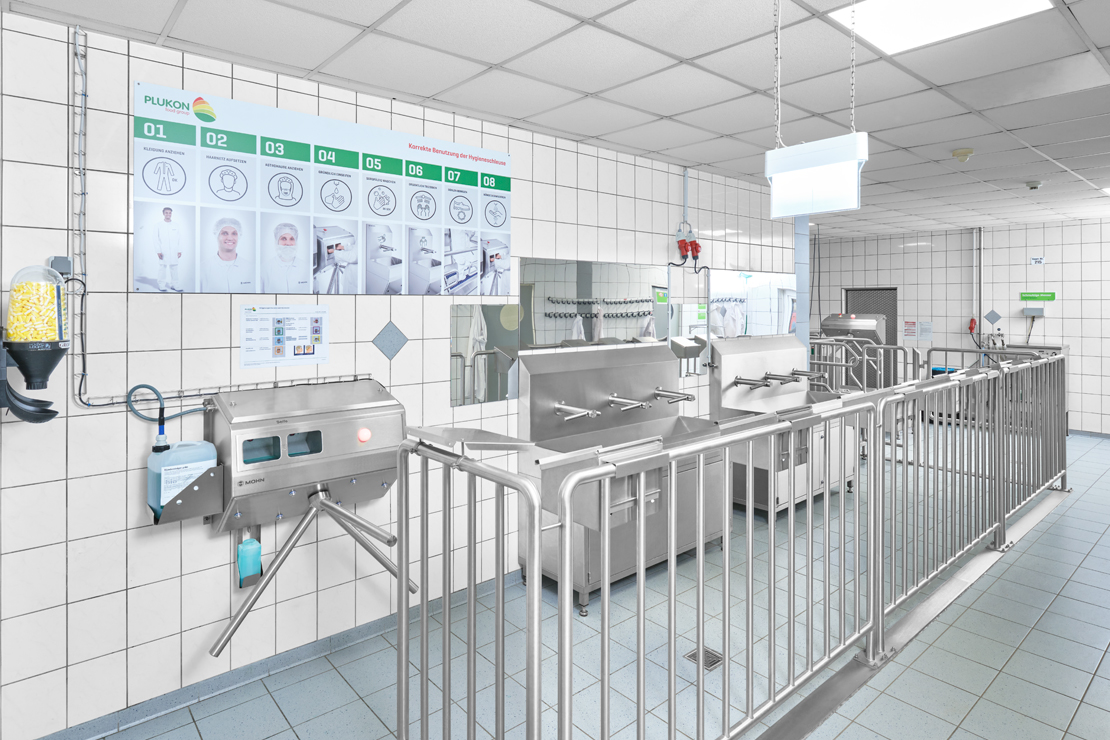
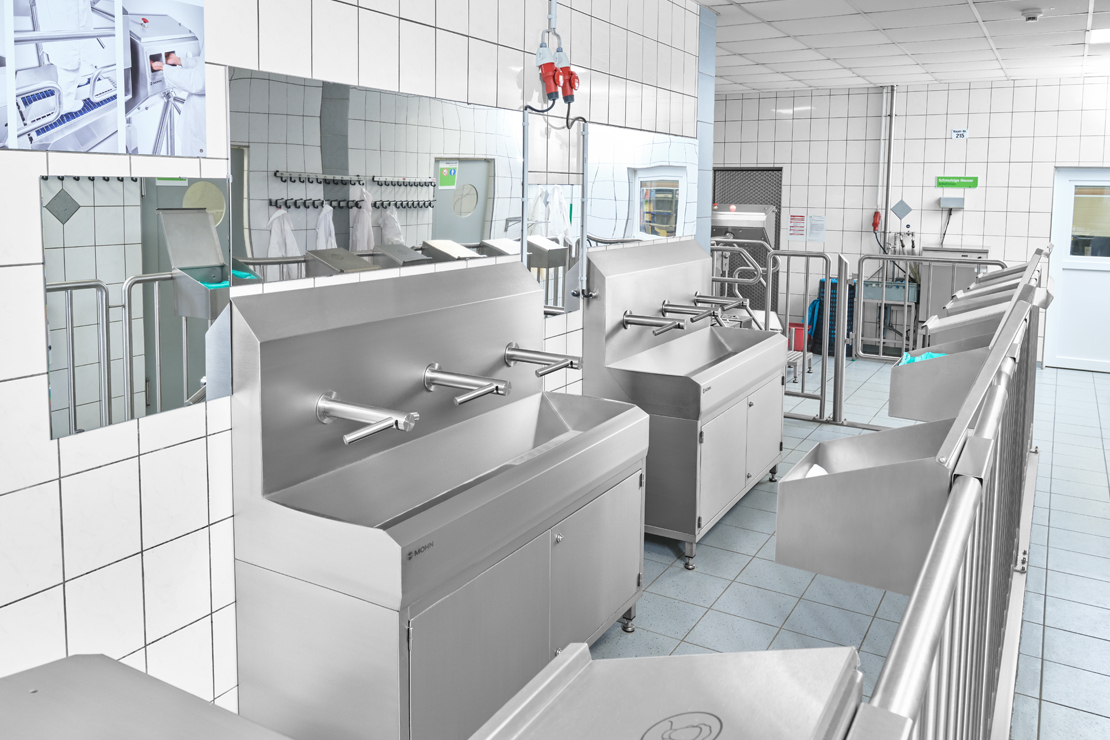
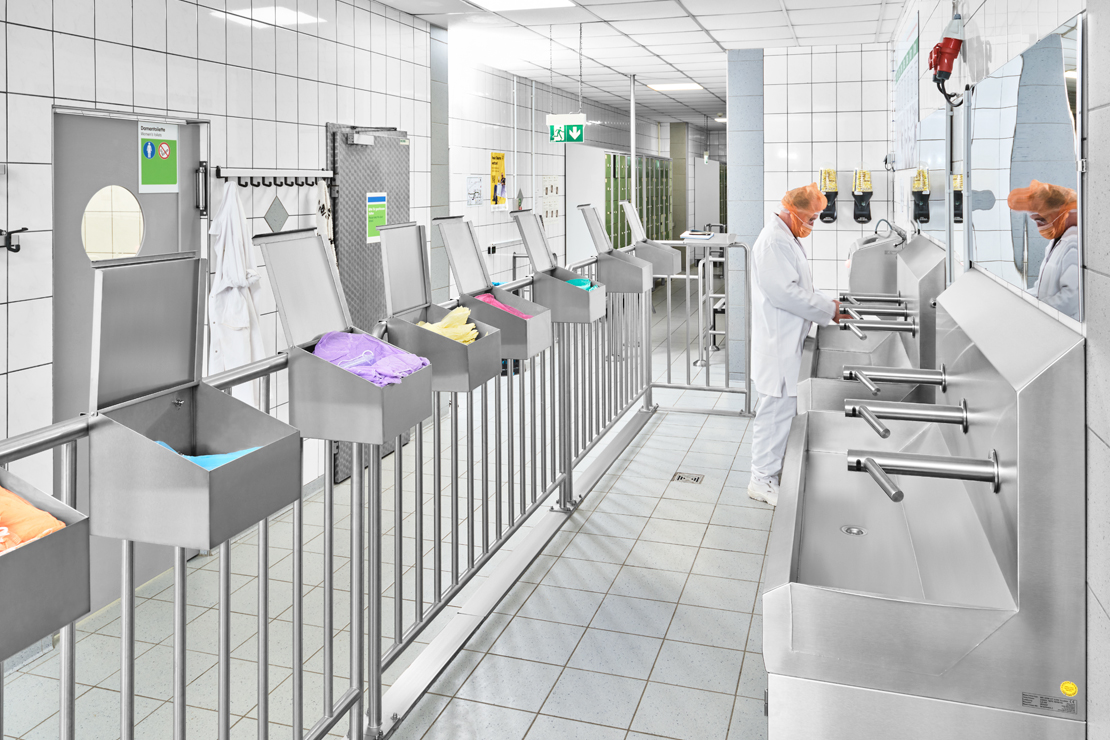
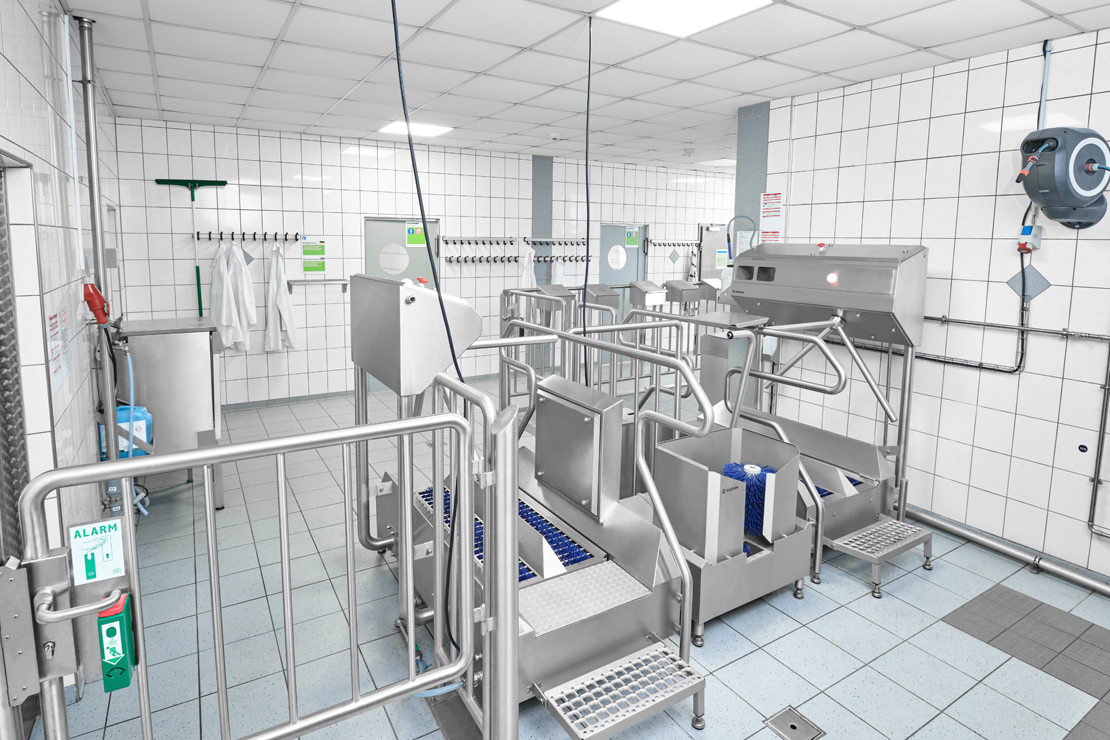
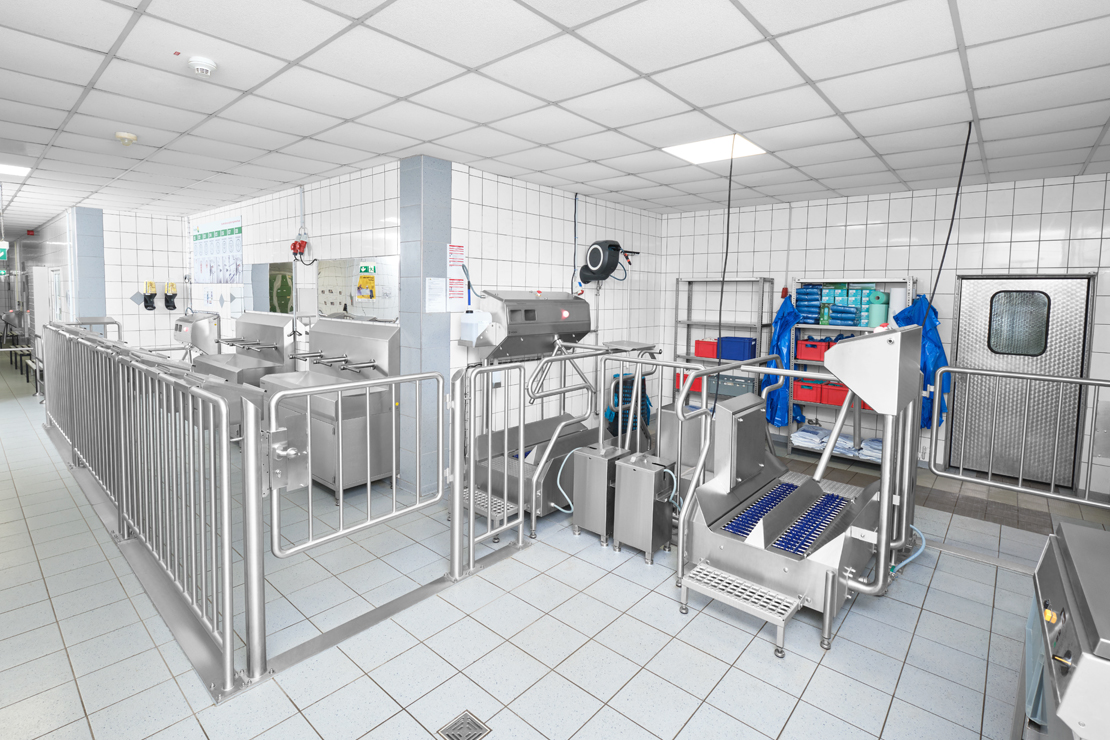
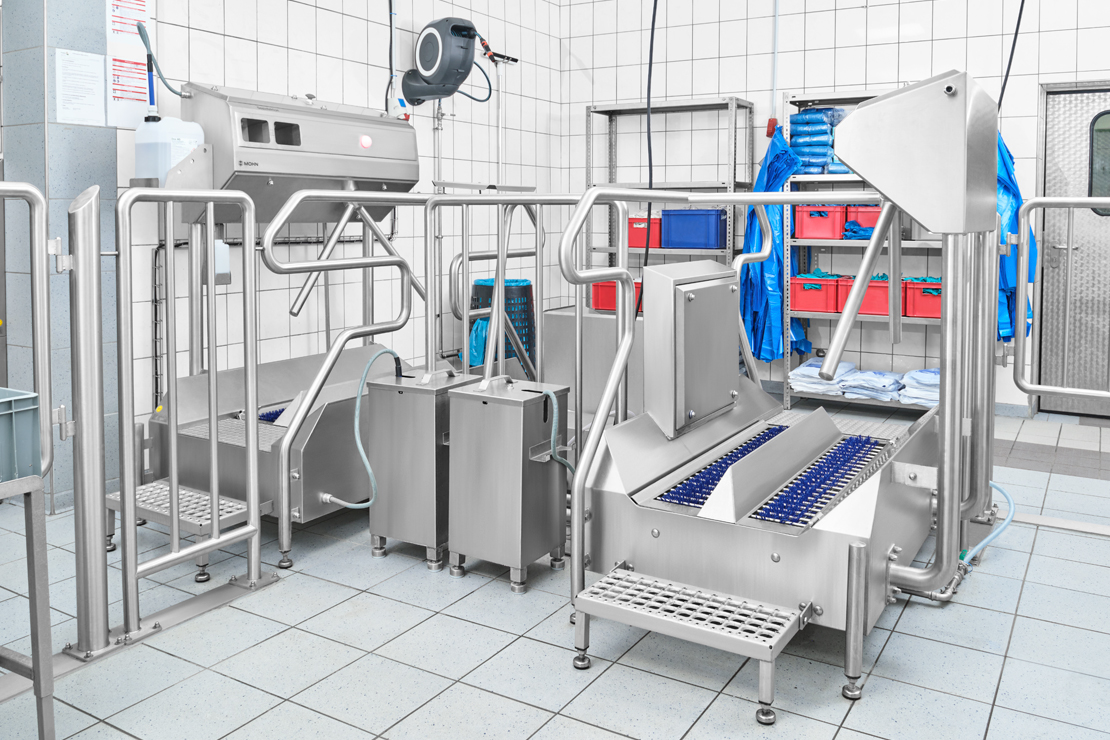
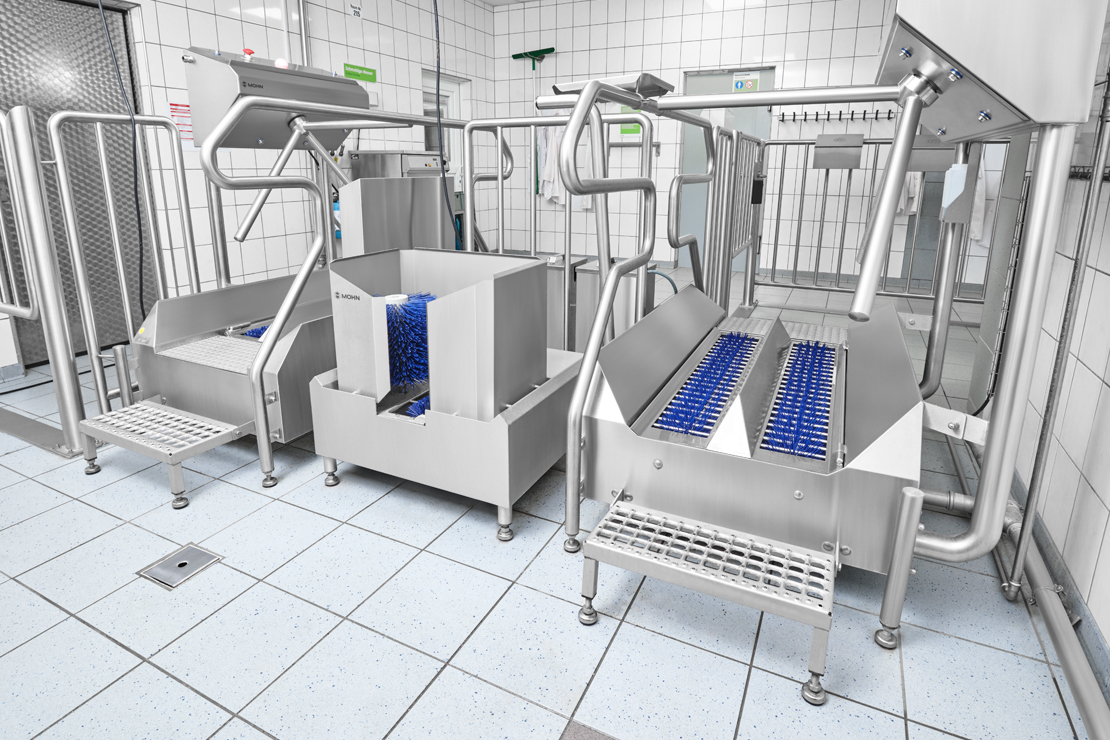
Personal hygiene sluice for the main entrance from the locker room/break room area into the production area - Please click on the images to enlarge them.
Project description and special features
The staff hygiene sluice, implemented in 2024, was designed as a multi-stage, comprehensive concept for the main entrance to the production area. The equipment used is not simply arranged side by side, but is linked via stainless steel guide barriers and directional turnstiles to form a clearly defined staff route.
1. Document tray – hands free for the hygiene process
Even before dispensing soap, staff can place any folders, waybills or other documents they are carrying on a dedicated stainless steel document tray. The tray is attached directly to the adjacent stainless steel handrail via a sturdy bracket and is thus positioned exactly where the hygiene process begins.
This means that documents do not need to be held or placed on the floor or on machine parts during the controlled two-handed soap application. Both hands remain free for the prescribed hygiene steps.
Practical benefit: The document tray is a small but important detail in the overall design. It prevents the use of makeshift storage spots and ensures a smooth workflow right from the moment staff enter the hygiene airlock.
2. Controlled soap dispensing
In the next step, the employee dispenses soap from the wall-mounted Soap-Control WL Highline. To do this, both hands must be inserted correctly into the dispensing slots at the same time. The sensor control system detects the position of both hands and only then dispenses the preset amount of soap.
The electric turnstile remains locked until the controlled two-hand soap application has been completed. The passage towards the hand-washing troughs is then released for exactly one person. In this way, the mandatory soap application cannot simply be skipped.
A multi-LED indicator in red, yellow and green clearly displays the current operating status. Control is handled by a Siemens LOGO! Generation 8, on which the relevant timings can be individually adjusted to suit operational requirements. A fully encapsulated IP68 sensor handles the end-position detection for the vandal-proof turnstile. Mohn provides a ten-year warranty on its mechanical components.
Industry-specific advantage: In poultry processing, consistent hand hygiene before entering sensitive production areas is essential. The technical authorisation logic ensures that the requirement to use soap is not merely an organisational stipulation, but is actually carried out as an integral part of the staff’s route.
3. Six hand-washing stations for a smooth flow of staff
After using the soap dispenser and passing through the turnstile, staff proceed to two WR-SRW-DT 3/24V Ecoline hand-washing troughs. Each trough has three washing stations, each 500 mm wide. This means a total of six washing and drying stations are available simultaneously.
This is particularly important at the start of a shift, after breaks and during staff changes. Several staff members can wash their hands at the same time, ensuring that the prescribed hygiene process is not unnecessarily delayed.
The sensors are located directly within the stainless steel taps. Water flow is activated touch-free, thereby avoiding additional contact points on the taps. Water-saving aerators and thermostatic mixing valves with non-return valves complete the technical specification.
Industry-specific advantage: In labour-intensive areas of poultry processing, large numbers of staff often need to enter the production area within a short space of time. Six wash stations that can be used simultaneously reduce waiting times and help to maintain an orderly hygiene workflow, even during shift changes.
4. Washing and drying directly at the same tap
The Dyson Tap WD06 technology used combines hand washing and hand drying at a single washstation. After washing their hands, staff do not need to move to a separate hand dryer or paper towel dispenser. Drying takes place immediately via the technology integrated into the stainless steel tap spout.
This keeps the distance travelled with wet hands to a minimum. Dripping water is largely contained within the wash trough area, rather than being carried onto walkways or into downstream hygiene areas.
At the same time, there is no need for disposable paper towels or the associated waste bins. This reduces the effort involved in refilling and disposal, as well as the risk of overflowing waste bins. The technical unit of the Dyson Tap systems is housed securely within the respective stainless steel base units.
Industry-specific benefit: In poultry processing, high hygiene standards go hand in hand with regular wet cleaning processes. The touch-free combination of washing and drying reduces contact surfaces whilst helping to prevent excess moisture on heavily used walkways.
5. Stainless steel mirrors for visual inspection
Mirror-polished stainless steel mirrors of the ESP-VII Glatt type complement the hand hygiene area. After washing and drying their hands, staff can check that their workwear and personal protective equipment are correctly fitted.
The mirror surface is streak-free and high-gloss polished on one side and has no visible inclusions. A 6 mm wide folded edge and a back-adhered backing panel made of Forex rigid foam stabilise the design.
Compared to conventional glass mirrors, stainless steel is shatter-resistant and is therefore particularly suitable for areas where hygiene is critical and where the equipment is subject to mechanical stress.
Practical advantage: Staff can check their appearance and the fit of their workwear whilst still within the controlled hygiene process – without having to visit an additional checkpoint outside the airlock.
6. Disposable protective equipment exactly where it is needed
After hand washing and drying, the staff route leads directly past five US-1-type equipment dispensers. The stainless-steel dispensers are mounted directly onto the 1,290 mm high guide barriers (handrails) and clearly present the required disposable protective equipment, such as hairnets.
Each dispenser is marked with an etched ‘mandatory’ sign. Unlike adhesive labels, the pictogram is permanently etched into the stainless steel surface and will not peel off, even after repeated cleaning.
The arrangement within the designated walkway ensures short distances. Staff do not need to leave the hygiene area or walk against the intended direction to collect any missing protective equipment.
Industry-specific benefit: particularly with a rotating workforce and high staff turnover, the clear pictogram labelling facilitates the rapid identification of single-use items. This streamlines the process and reduces the need for enquiries or unnecessary walking distances during shift changes.
7. Controlled hand disinfection and sole cleaning in a single pass
The Clean-Check 1500 L Highline handles the final, guided hygiene step before entering the production area. Whilst hands are disinfected in a controlled manner in the upper section, the rotating brush rollers in the lower section simultaneously clean the soles of the shoes.
For hand disinfection, both hands must be correctly inserted into the sensor area at the same time. Only once the tamper-proof sensor control system has detected both hands and dispensed the prescribed amount of disinfectant is the electric turnstile released for one person.
At the same time, the employee steps onto the walkway over the 1,100 mm-long brush rollers. The soles of the shoes are mechanically cleaned and treated with the designated cleaning or disinfectant. As sole cleaning is integrated directly into the walkway, it cannot be bypassed during normal access.
Here too, the multi-LED display indicates the current status in red, yellow and green. The vandal-proof turnstile is fitted with an encapsulated IP68 sensor for end-position detection. We provide a ten-year warranty on the turnstile mechanism of the Highline series.
Hygiene Plus for the poultry industry: Shoe soles can transfer moisture, organic residues and other contaminants between traffic, staff and production areas. The combination of controlled hand disinfection and guided sole cleaning addresses both relevant transmission routes in a single pass.
8. Brushes only start when the user actually steps inside
A distinctive feature of the Highline sole cleaning system is the precise activation of the brush rollers. They do not start as soon as a person approaches the hygiene sluice, but only when the employee actually steps onto the grating above the brush surface.
This is made possible by the patented spring-pot technology in conjunction with an inductive sensor. The system reacts immediately upon entry; once the employee has left the brush area, rotation stops in accordance with the set control parameters.
Unlike optical activation via reflective light sensors, the function is not dependent on the colour or reflectivity of the workwear. Even people wearing dark workwear are reliably detected.
Unnecessary idle time before entering or after leaving the facility is avoided. Water, cleaning chemicals and electricity are therefore only used during the actual cleaning process.
Industry-specific benefit: With high staff turnover, even a few seconds of unnecessary brush running time can add up over the course of a working day. Activation on demand reduces resource consumption and, consequently, the ongoing operating costs of sole cleaning.
9. Secure storage of process chemicals
The container required for sole cleaning is housed in a lockable stainless-steel canister holder. This accommodates a 24-kg canister and protects the process chemical used from unauthorised access.
The separate sole-cleaning sluice on the return route is also equipped with a KB-ESV-type canister container positioned directly on the machine. The containers are thus organised and housed close to their respective points of use.
The lockable canister containers protect the process chemicals in use from unauthorised access and thus support the operational food defence concept as set out in Chapter 6 of IFS Food 7.
Food defence benefit: The lockable storage makes tampering more difficult and prevents freely accessible chemical containers from becoming an avoidable source of risk within the hygiene area.
10. Additional boot cleaning for particularly high-wear work areas
Not all staff enter the production area wearing work shoes or clogs. For staff wearing work boots, a Boot-Master Highline has therefore been integrated into the hygiene process.
The machine is used after controlled hand disinfection and sole cleaning. Rotating brushes clean both the soles of the boots and the upper sections. The employee holds onto the handrail; a sensor integrated into it activates the cleaning process.
The cleaning or disinfectant solution is supplied via an adjustable dosing system. The brushes can be removed without tools, allowing the machine to be cleaned quickly and thoroughly. Internal components are accessible via an inspection flap, which facilitates maintenance and servicing.
Boot cleaning is deliberately designed as a supplementary process step. It does not have a control system that enforces a specific sequence, as it is only required by those staff members who actually wear boots.
Industry-specific advantage: In wet or heavily soiled areas of poultry processing, dirt can accumulate not only on the soles but also on the boot shafts. The additional shaft cleaning takes this increased wear and tear into account without unnecessarily prolonging the process for employees wearing work shoes or clogs.
11. Mandatory sole cleaning even when leaving the production area
The return route from production does not pass through the Soap-Control or the regular access route. A separate, specially designed version of the Clean-Check 1500 L Highline is available for this purpose.
This return passage does not feature hand sanitisation, but instead has an electric, vandal-proof DK-E turnstile. Upon stepping onto the grating, sole cleaning is activated and passage from the production area towards the changing rooms and washrooms is granted.
The opposite direction is permanently blocked. Consequently, no one can gain unauthorised access to the production area via the return passage. Anyone wishing to enter the production area must always complete the full staff hygiene process via Soap-Control, hand-washing troughs and Clean-Check.
Staff wearing work boots also use the Boot-Master on their return journey to clean the soles and uppers of their boots before moving into the adjacent areas.
Result: The separate routing prevents staff from bypassing the personal hygiene procedures and, at the same time, reduces the spread of production-related contaminants into changing rooms, sanitary facilities and circulation areas.
12. Clear routing via guide barriers
The 1,290 mm high stainless steel guide barriers (handrails) with vertical struts clearly demarcate the access route, return route and adjacent areas from one another. They ensure that the installed hygiene units cannot be accessed at random, but are situated in the intended sequence along the staff route.
At the same time, the guide barriers fulfil additional functions: the document holder and the five utensil dispensers are attached to them. The necessary equipment is thus located directly along the route, without taking up any additional floor space in the airlock area.
Together with the direction-controlled turnstiles, this creates a clear route. The structural design supports the hygiene process in areas where organisational signage or floor markings alone would not be sufficient.
A practical advantage: the clear separation of the outward and return routes reduces the likelihood of people taking the wrong route and ensures an orderly flow of people, even during shift changes. Several individual units are thus combined to form a coherent staff hygiene airlock.
13. Dedicated access for cleaning, care and maintenance
Hygiene sluices must be cleaned, inspected and maintained regularly. To ensure that the staff responsible do not have to pass through all the turnstiles and hygiene stations to carry out these tasks, a separate GT-1000 Type III/AR stainless steel railing gate has been provided.
The gate provides direct access to the system for cleaning, care and maintenance work. A door monitor with a pre-alarm system monitors the opening and immediately detects any unauthorised use.
The fittings also include a mortise lock without a profile cylinder and a stainless steel door handle with a matching stainless steel knob on the opposite side. The gate is intended solely as access for maintenance and cleaning. It is neither part of the regular staff route nor designed as an escape or emergency exit.
Service benefit: The machines remain easily accessible for daily cleaning and technical work without having to alter the staff’s established route.
14. Separate escape route – independent of the turnstiles
To the right of the return passage, a second stainless steel railing gate with a passage width of 1,000 mm has been installed. Unlike the maintenance access point, this gate is specifically intended as an escape route.
The railing gate is fitted with a door monitor with a pre-alarm function and an anti-panic locking mechanism. During normal operations, the controlled access route through the hygiene sluice is maintained. In the event of an emergency, however, an exit independent of the electrically controlled turnstiles is available.
The physical and functional separation of the two gates establishes clear responsibilities: one entrance is for cleaning and maintenance, the other exclusively for safe evacuation.
Conclusion: The personnel hygiene sluice combines a process flow that is essential during normal operation with a separate safety route. Hygiene requirements and personal safety are thus not pitted against one another, but are taken into account within a coordinated overall concept.
15. Customised graphic display – so that the hygiene process is understandable at a glance
A technically defined hygiene sequence only realises its full benefit when it is quickly and clearly understood by staff. That is why Mohn also developed and designed a customised graphic board made from DIBOND® for the staff hygiene airlock.
The board visualises the prescribed hygiene steps with easy-to-understand illustrations directly within the hygiene sluice area. This enables staff to recognise at a glance which steps need to be carried out and the order in which the hygiene process must be followed. Particularly for newly trained or foreign-language-speaking staff, the visual representation aids quick orientation and reduces misunderstandings caused by language barriers.
The design, colours and layout were tailored to the client’s corporate identity. As a result, the graphic panel does not look like standard signage added as an afterthought, but rather like an integral part of the overall spatial and hygiene concept.
The dimensionally stable DIBOND® aluminium composite panel is suitable for long-term use in hygiene-sensitive areas. Its smooth surface is easy to clean and is resistant to moisture and the usual stresses and strains encountered in hygiene areas.
The Mohn difference: Mohn not only supplies the machinery and the technical guidance system, but also takes the day-to-day use by staff into account. From defining the process steps to the customised design of the graphic board, the technical and visual guidance for staff is provided from a single source – tailored to the hygiene airlock, operational processes and the customer’s corporate identity.
In case of questions on this project, we would like to advise you by telephone on +49 (2354) 94450, or please use our contact form.
We would also like to call you at the requested time. So you can determine the date and time.
For this, just use our callback service.